

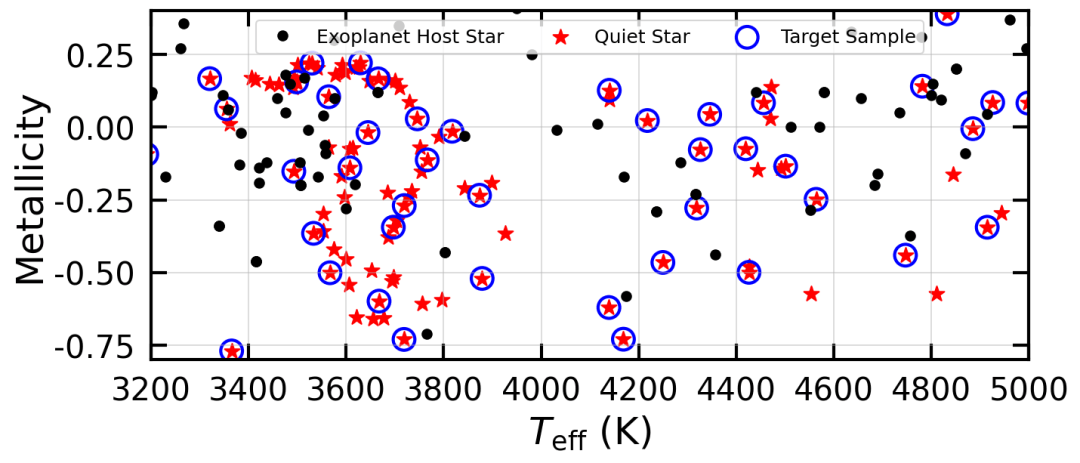
Overlap of quiescent K and M dwarfs (red stars) with transiting exoplanet hosts (black dots) in stellar Teff and metallicity space. The range of targets selected for this proposal (blue circled red stars) allows for broad expansion and testing of model atmospheres in this parameter space.
Requested Allocation of 79.7 hours (1 of 254 approved proposals out of 2,855 submitted)
Proposal Team:
CoI Prof. Daniel Apai University of Arizona USA/AZ
CoI Dr. Luigi R. Bedin INAF - Osservatorio Astronomico di Padova ITA
PI Dr. Mark S. Giampapa University of Arizona USA/AZ
CoI Dr. Kevin K. Hardegree-Ullman California Institute of Technology USA/CA
CoI Dr. Aishwarya Iyer NASA Goddard Space Flight Center USA/MD
CoI Dr. Chia-Lung Lin University of Arizona USA/AZ
CoI Dr. Benjamin Rackham Massachusetts Institute of Technology USA/MA
CoI Dr. Alexander I. Shapiro University of Graz, Austria
Limited fidelity in stellar models poses a bottleneck in multiple fields of astrophysics, including correcting exoplanet transmission spectra for host star heterogeneity (“stellar contamination”). Accurate corrections for magnetically active stellar surface regions require either refined model precision or empirical solutions. We propose establishing a JWST Spectral Library for Cool Stars, providing high-precision, flux-calibrated spectra critical for validating and refining current stellar model atmospheres. This library will benchmark next generation models and offer empirical spectra for accurate transmission spectrum corrections. Featuring high-resolution NIRSpec spectra of 43 carefully selected magnetically quiescent stars (3200 K–5000 K) across a broad metallicity range, it will encompass ~90% of known transiting exoplanet hosts amenable to JWST transmission spectroscopy. The project will enhance atmospheric characterizations of rocky planets and provide an immediate, valuable community resource for modeling cool stellar atmospheres, thus supporting JWST’s mission and serving as a legacy asset